Journeys
Paraty and Ilha Grande, the coast between São Paulo and Rio
Between Brazil's two great cities lies a stretch of coast where the rainforest comes down to the sea, a colonial town floods its own streets at high tide, and an island has no cars at all.
By Walter Pellow2 November 20264 min read
Most visitors fly into Rio de Janeiro and stay there, which is understandable: few cities have a setting to match it. But the coast to the south-west, towards São Paulo, is one of the most beautiful in South America, and it is worth the few hours on the road. Brazilians call it the Costa Verde, the green coast, and the name is accurate. The mountains of the Serra do Mar rise straight from the water, still covered in Atlantic rainforest, and the shore below them breaks into hundreds of bays, coves and islands.
Two places on it repay a stop. Paraty is a small colonial town that grew rich on gold and then, for the best part of a century, was more or less forgotten. Ilha Grande is a large, mountainous island offshore that spent much of the twentieth century as a prison and has no roads for cars.
Paraty, the town the gold road built
In the late seventeenth century, gold was found in the hills of Minas Gerais, inland from Rio. The richest strikes in the Americas needed a way to the sea, and for a time the route ran down an old trail through the mountains to Paraty, where the gold was loaded onto ships for Rio and Portugal. The town grew prosperous on the traffic, and the merchants built solid, whitewashed houses with coloured doors and window frames, laid out on a neat grid of streets around the church.
Then the trade moved away. A more direct road to Rio was opened, and later the railways passed Paraty by. The town dwindled, and because nobody had the money to knock it down and start again, it survived much as it was. When a road finally reached it in the 1970s, visitors found an almost intact colonial port, and the historic centre is now protected.
The streets of the old town are paved with large, uneven stones, and they are closed to cars. Walking them takes some care; the stones are said to have come from the ballast of ships. The streets also slope gently towards the sea, and on the highest tides the water comes up into the lower ones and then drains away again. It is often described as a deliberate piece of colonial engineering for washing the streets, though that may be a story told after the fact. Either way, the sight of the sea standing in a street of white houses is one of the things people remember about Paraty.
The town is a good base for a day on the water. Schooners leave the harbour each morning for the islands and beaches of the bay, and the forest behind the town hides waterfalls and old cachaça distilleries: the region was known for its sugar-cane spirit long before it was known for anything else.
Ilha Grande, an island with no cars
Ilha Grande lies a short boat ride off the mainland, further towards Rio. It is a big island, mostly mountain and rainforest, with a long coastline of beaches, some reached only on foot or by boat. Its main village, Abraão, is where the ferries come in, and it has guesthouses, restaurants and dive shops, but no cars: the island has no roads to drive them on.
The reason it has stayed so undeveloped is its history. For much of the twentieth century the island was home to a prison, and its reputation kept visitors and builders away. The prison was closed and demolished in the 1990s, and the island's protection as a state park has kept development limited since.
What the island offers is walking and swimming. Trails cross the forested ridges between the bays, past ruins of the old prison and colonial plantations, to beaches such as Lopes Mendes on the ocean side, often listed among the finest in Brazil. Boats run around the island to snorkelling spots in clear, sheltered water. In the forest, monkeys and toucans are common enough to be seen without much searching.
The overland route to Rio
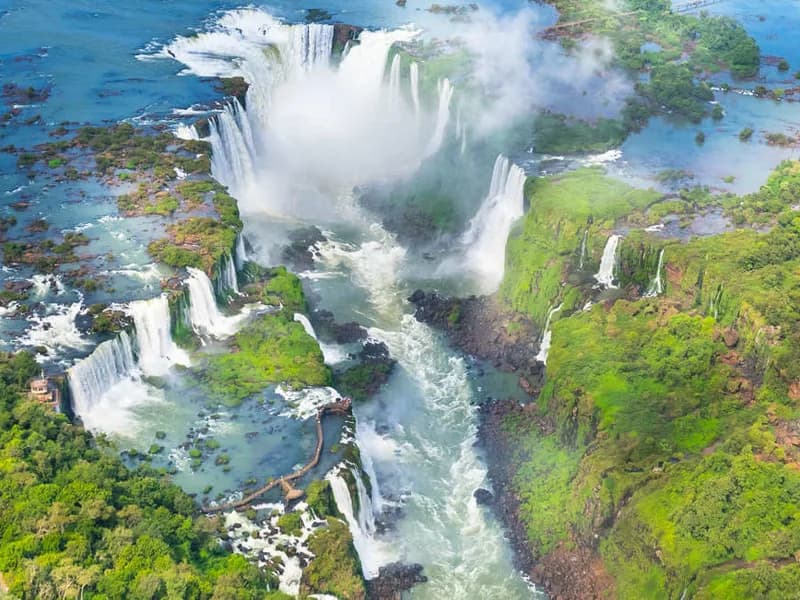
Explore Worldwide's Buenos Aires to Rio, twelve nights, makes this coast the final stretch of a longer journey. It starts in Buenos Aires, crosses to the Iguazú Falls at Puerto Iguazú, and then works its way to the Brazilian coast, stopping at Paraty and Ilha Grande before finishing in Rio de Janeiro. It runs through most of the year.
For a broader first look at the continent, Travelsphere's Chile, Argentina & Brazil with Rio de Janeiro Add-on, fifteen nights, starts in Santiago and crosses the Andes to Mendoza, then visits Buenos Aires and the Iguaçu Falls before ending in Rio. It does not stop on the Costa Verde, but it reaches the city at the far end of it.
The coast is green for a reason: it rains a good deal, especially in the southern summer, from December to March. The drier months, from roughly May to September, are cooler and calmer, and well suited to walking on Ilha Grande. Whenever you go, Paraty is worth a night rather than a day, so that you see the old town after the day-trippers have gone, when the stones are lit and the bay is still.
By Walter Pellow, the name Atlas & Passage’s editorial team writes under. Prices and dates in the trips below come from the operators and can change.