Journeys
Wadi Rum, a night in the desert Lawrence wrote about
In the south of Jordan, mountains of sandstone and granite rise from a desert of red sand, with Bedouin camps tucked against their cliffs. T. E. Lawrence passed through during the Arab Revolt and called it vast and echoing. A night there under the stars is one of the great experiences of the Middle East.
By Walter Pellow20 October 20264 min read
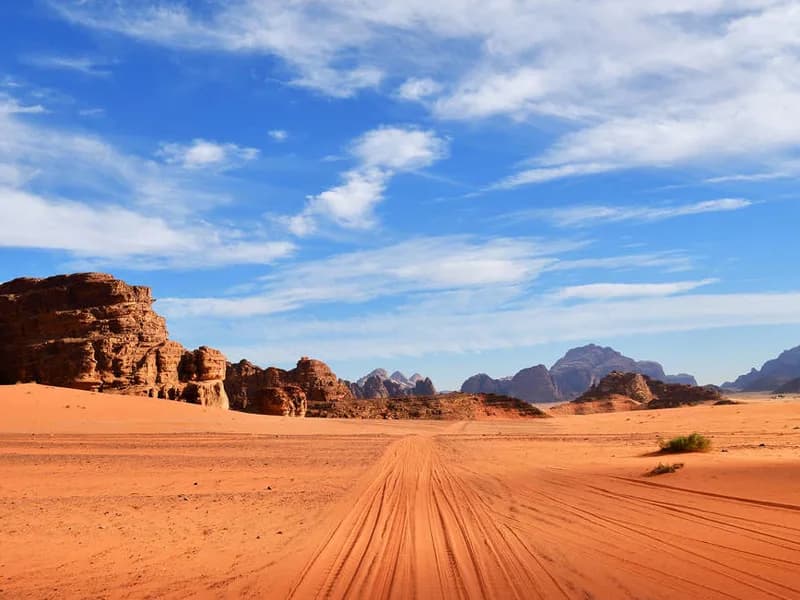
Wadi Rum is a wide desert valley in the far south of Jordan, close to the Saudi border and not far from the Red Sea. It is unlike any other desert. Instead of endless dunes, it is a landscape of great sandstone and granite massifs rising sheer from flat valleys of soft red and orange sand, their cliffs weathered into domes, fins and towers that glow in the evening light. Jordan's highest mountain, Jebel Umm ad Dami, rises on its southern edge. The valley is a protected area and a World Heritage Site, listed both for its landscape and for the thousands of rock inscriptions and carvings left by the people who have passed through it over thousands of years.
Lawrence in the desert
During the First World War, the Arab Revolt against Ottoman rule was fought across these deserts. Its forces, led by Prince Faisal and supported by the British, moved through Wadi Rum on the campaign that led to the capture of the port of Aqaba in 1917. Among them was a young British officer, T. E. Lawrence, later famous as Lawrence of Arabia. In his book Seven Pillars of Wisdom, he described riding into Wadi Rum, and his phrase for it, "vast, echoing and God-like", has followed the place ever since. One great mountain near the visitor centre has been named the Seven Pillars of Wisdom after the book, and a spring in the valley is known as Lawrence's Spring.
How much of Lawrence's own account to believe is a long-running debate among historians. But the landscape is everything he said. The 1962 film Lawrence of Arabia was partly filmed here, and Wadi Rum has since stood in for other planets in a number of science fiction films.
Exploring the valley
Most visitors explore the desert in four-wheel-drive vehicles driven by local Bedouin guides, stopping at its best-known sites. These include narrow canyons such as Khazali, whose walls are carved with ancient inscriptions and drawings of people and animals; natural rock bridges, the largest of which, Burdah, can be climbed with a guide; and red sand dunes banked against the cliffs. Camel rides and walking are slower and more rewarding ways to see it, and the silence of the desert is best appreciated on foot.
The Bedouin of Wadi Rum, mainly of the Zalabia tribe, still live in and around the village of Rum, and many now work in tourism as guides, drivers and camp hosts.
Wadi Rum is also one of the great climbing areas of the Middle East. Its sandstone walls rise hundreds of metres from the desert floor, and the Bedouin have long known routes to the summits, used for hunting and reaching water. Since the 1980s, climbers from around the world have come to put up new routes, and scrambling and climbing with local guides are possible for those with a head for heights.
A night in the desert
The best way to experience Wadi Rum is to stay the night. Camps, ranging from simple Bedouin tents of goat hair to more comfortable bubble tents, are tucked into the sheltered corners of the cliffs. The evening routine is the same everywhere. You climb a rock to watch the sunset turn the mountains red, then purple, and then the stars come out. With no light pollution, the night sky is spectacular. Dinner may be zarb, meat and vegetables cooked slowly in a pit in the sand, and it is followed by sweet tea around the fire.
The desert is hot by day in summer and cold at night in winter, when temperatures can drop close to freezing. Spring and autumn are the most comfortable seasons.
Explore Worldwide's Jordan Discovery, eight nights, includes Wadi Rum along with Amman, Jerash, Madaba, Mount Nebo, Kerak, Petra, Aqaba and the Dead Sea.
Explore Worldwide's Walking Jordan's Spice Trails, seven nights, is a walking trip. It includes Wadi Rum, Petra, Wadi Shamassat and Little Petra, as well as Amman, Kerak, Madaba, Mount Nebo, the Dead Sea and Jerash. Just You's Jordan, a Land of Ancient Treasures and Empires, seven nights for solo travellers, includes Wadi Rum on a route through Amman, Jerash, Madaba, Mount Nebo, Petra, Shobak and the Dead Sea.
Take warm layers for the night even in the warmer months, and a torch. And put the phone away for an hour after dark. The sky is the point.
By Walter Pellow, the name Atlas & Passage’s editorial team writes under. Prices and dates in the trips below come from the operators and can change.