Culture
Zagreb, the upper town and the lower
Croatia's capital began as two rival hilltop towns, one of churchmen and one of merchants, that were not joined until 1850. Below them, after an earthquake, the city built a horseshoe of parks and palaces. The two halves still feel like different places.
By Walter Pellow2 November 20264 min read
Most visitors to Croatia head for the coast, and Zagreb is the city they land in and leave as soon as they can. That is a pity, because the capital has a shape and a story that the coast cannot offer. It is a city of two levels. Up on the hill is the old Zagreb, the Gornji Grad or Upper Town, a place of steep lanes, churches and gas lamps that are still lit by hand. Down on the plain is the Donji Grad, the Lower Town, a grid of nineteenth-century streets, theatres, museums and parks. A funicular joins them, and so do a good many flights of steps.
Two towns on two hills
The Upper Town was itself once two towns, and they did not always get on. On one hill stood Kaptol, the seat of the bishop and his chapter, the church's town, with the cathedral at its heart. On the hill next to it stood Gradec, a town of merchants and craftsmen with its own walls, its own rights and its own council. The two communities quarrelled for centuries, and a street between them, Krvavi most, the Bloody Bridge, is named after the fights on the wooden bridge that once crossed the stream there. They were finally merged into a single city of Zagreb only in 1850, under the administration of Ban Josip Jelačić.
One of Gradec's defensive towers still stands. The Lotrščak Tower dates from the thirteenth century, and every day at noon a cannon is fired from it, a custom that has been kept since 1877. Its practical effect is to make every visitor in the Upper Town jump.
Every day at noon a cannon is fired from the Lotrščak Tower; its practical effect is to make every visitor in the Upper Town jump.
Just below the tower, the funicular runs down to the Lower Town. It is often described as the shortest funicular in the world, and the journey is over almost before it has begun, but it is a cheerful old thing and saves a climb.
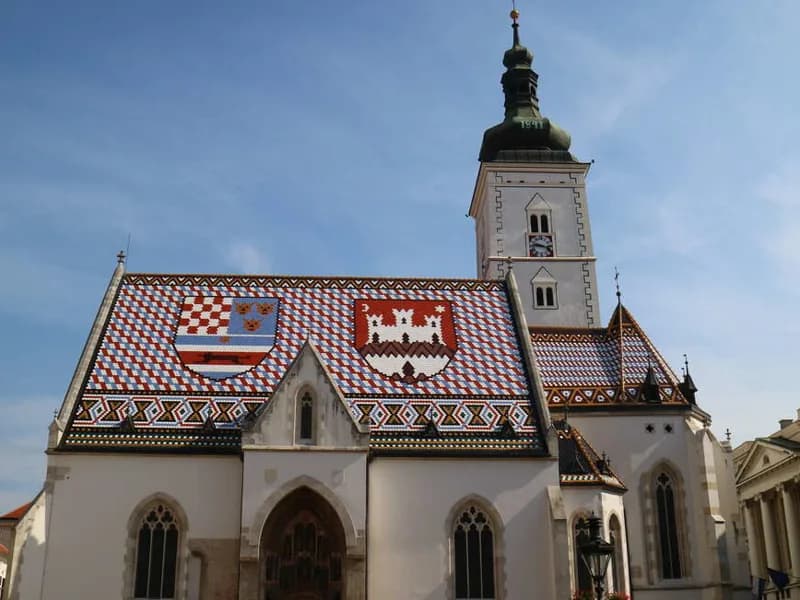
At the heart of Gradec is St Mark's Square, and in the middle of it St Mark's Church, which most people know from its roof. It is laid in coloured tiles, in patterns that make it look more like a piece of embroidery than a roof, and it is one of the pictures of Zagreb that everyone takes home.
The Stone Gate
The most moving place in the Upper Town is a gateway. The Stone Gate, Kamenita vrata, is the last of Gradec's old town gates, and inside its dark arch is a small shrine. In 1731 a great fire swept through the town, which was built largely of wood, and badly damaged the gate. According to the city's tradition, a painting of the Virgin Mary that hung inside the arch came through the fire unharmed. Whether you take that as a miracle or a stroke of luck, the people of Zagreb have taken it to heart. Candles burn there, and people stop to pray on their way through.
The Lower Town and the horseshoe
On 9 November 1880 an earthquake shook Zagreb and damaged a great part of the city, including the cathedral on Kaptol. Its restoration, led by the architect Hermann Bollé, took until 1906 and gave the cathedral the neo-Gothic form it has today.
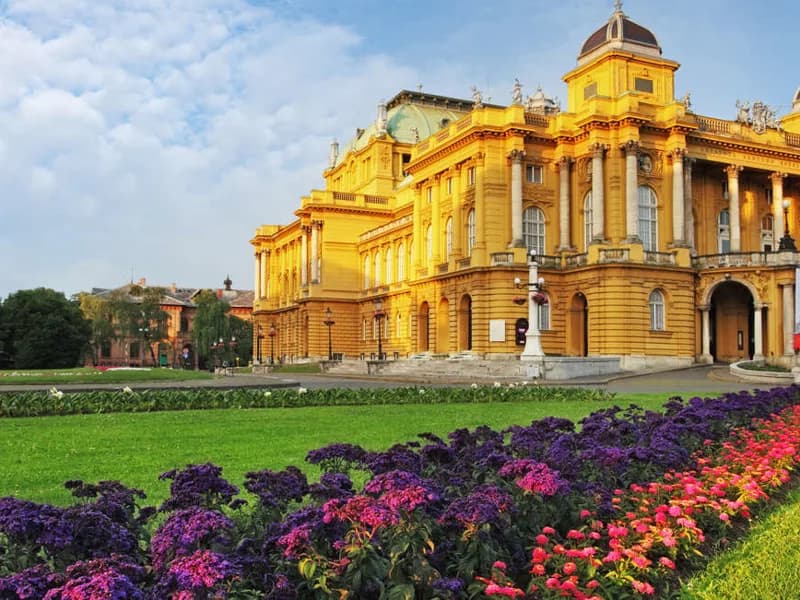
The earthquake also cleared the way for the Lower Town. The city was growing fast, and its planners laid out a new district on the plain below the hill, with a feature that is still its pride: the so-called Green Horseshoe, named after the urban planner Milan Lenuci, who designed it. It is a U-shaped chain of eight squares and parks, with the botanical garden among them, and around them stand the public buildings of a confident nineteenth-century capital, theatres, museums, galleries and grand houses. The effect is of a city that wanted to be taken seriously, and planned accordingly.
To walk from the one Zagreb to the other is to cross centuries in a few minutes. Up the hill, the lanes are crooked and the clock is set by a cannon. Down below, the streets are straight, the trams run, and the parks are laid out with a ruler.
Tours that start in Zagreb
All three tours here list Zagreb among their places, and from the city they go on to Plitvice Lakes National Park and the coast.
Explore Worldwide's seven-night Walks and Coastal Towns of Croatia runs in April, May, June and September. From Zagreb its places include Medvednica mountain, Plitvice Lakes National Park, the Velebit mountain range, Paklenica Gorge, Zadar, Krka National Park and Split.
Explore Worldwide's seven-night Upgraded - Highlights of Croatia runs in May, June and September, with Zagreb, Plitvice Lakes National Park, Zadar, Šibenik, Trogir, Split and Dubrovnik among its places.
Travelsphere's twelve-night Balkan Highlights goes further, into Serbia and Bosnia and Herzegovina, with Zagreb alongside Split, Zadar, Plitvice, Novi Sad, Belgrade, Sarajevo and Mostar among its places.
If you have a free afternoon in Zagreb, I would spend it in the Upper Town, and make sure to be near the Lotrščak Tower at noon. Then go down by funicular, and walk the horseshoe slowly.
By Walter Pellow, the name Atlas & Passage’s editorial team writes under. Prices and dates in the trips below come from the operators and can change.