History
Borobudur, the mountain built as a diagram
A ninth-century monument shaped like a map of enlightenment itself, buried by ash and jungle for centuries, and still meant to be walked rather than simply looked at.
By Arthur Penhallow26 September 20264 min read
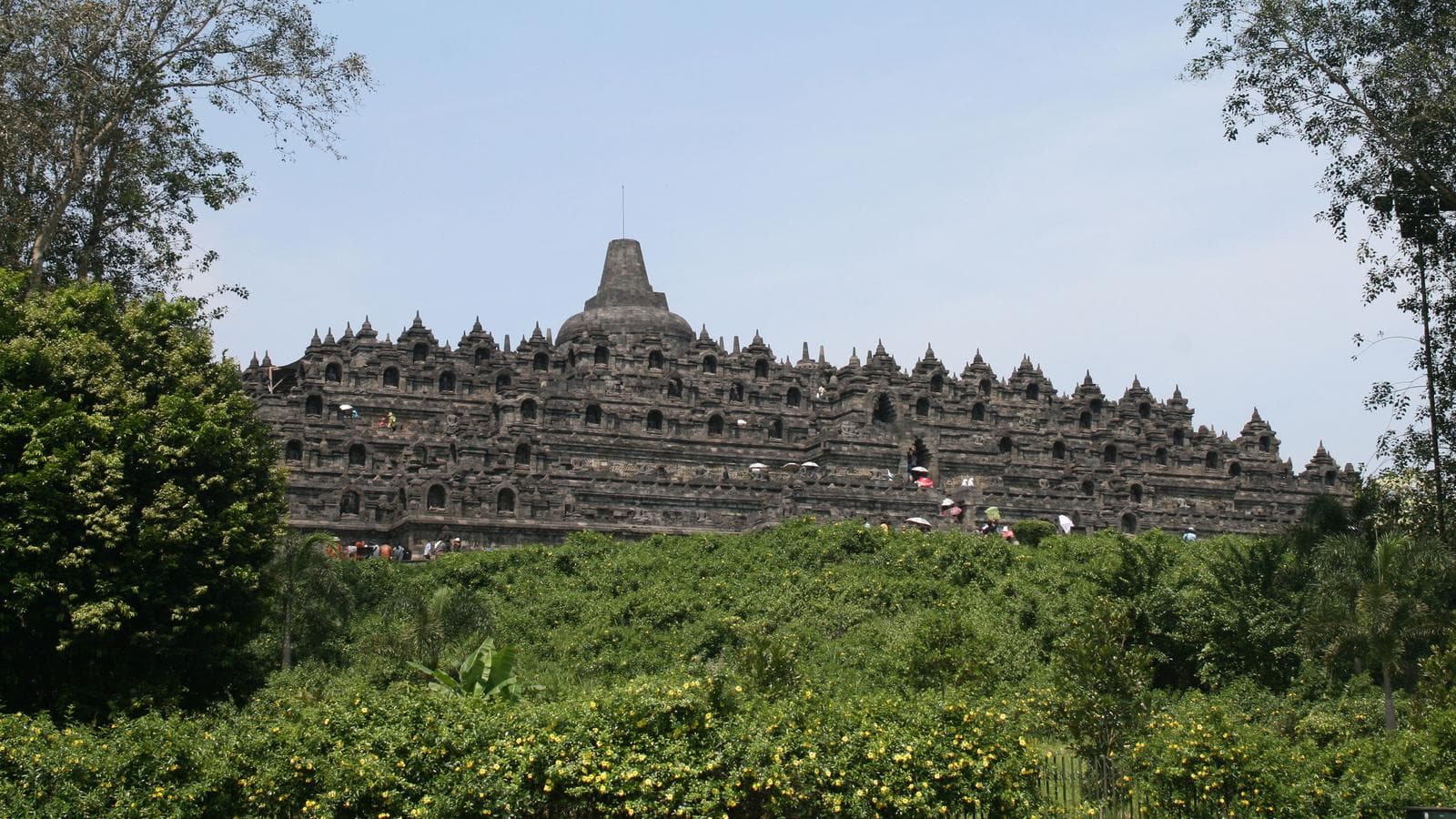
Most great monuments are built to be seen. Borobudur, on the plain outside Yogyakarta, was built to be walked, in a specific direction, along a specific route, by pilgrims who were meant to arrive at the top having gone somewhere rather than simply looked up at something. It is, in effect, a diagram you climb.
A mandala with steps
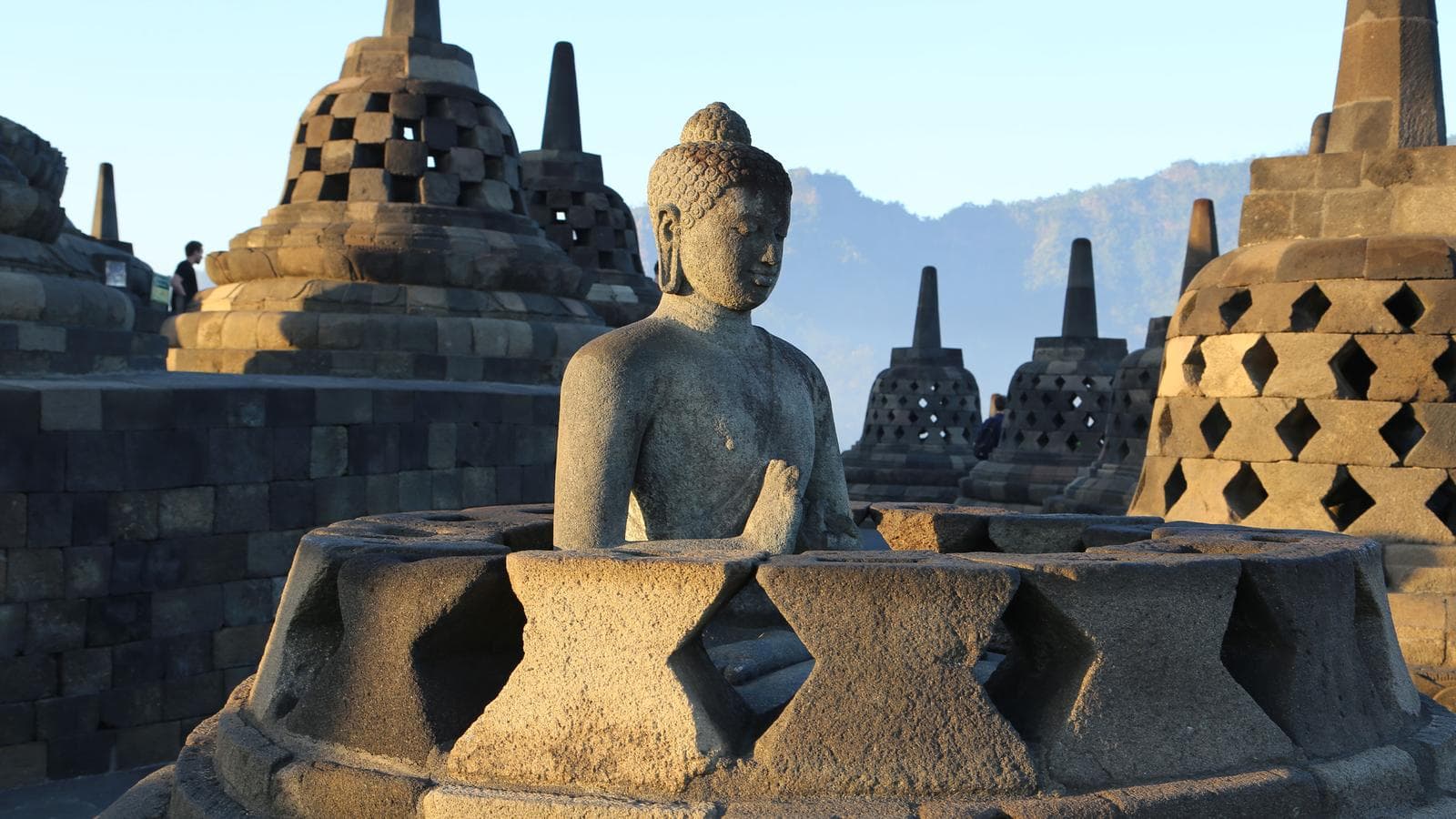
The monument was raised in the early ninth century under the Shailendra dynasty, a Mahayana Buddhist ruling family in central Java, using an estimated two million stone blocks fitted without mortar. Its structure follows a Buddhist cosmology in three tiers: a hidden base representing the world of desire, five square terraces lined with relief carvings representing the world of form, and three circular upper terraces, open to the sky, holding bell-shaped stupas around a central dome, representing formlessness. Pilgrims circled each level clockwise before ascending to the next, reading the carved reliefs as they went, a sequence of narrative panels depicting the Buddha's life and Buddhist teaching stories in roughly two and a half kilometres of stone relief altogether.
Buried, not lost
Borobudur's active use declined by around the fourteenth century, as Java's rulers and population shifted towards Islam and the political centre of gravity moved east, and volcanic ash from nearby eruptions gradually buried much of the monument under earth and jungle growth. It would be a stretch to call it "lost", exactly: local communities knew the mound was there, and it appears in occasional colonial-era reports through the eighteenth century. What changed in 1814 was that Thomas Stamford Raffles, then the British lieutenant-governor of Java during a brief period of British control, ordered a systematic clearance and survey, bringing it to wider international attention. A much larger restoration, coordinated by UNESCO and the Indonesian government, ran through the 1970s and 1980s, involved dismantling and cleaning close to a million individual stone blocks and fitting a proper drainage system beneath the terraces to stop rainwater doing the same slow damage that had helped bury the site in the first place, and remains the basis of what visitors see today.
Reading the relief panels
The two and a half kilometres of narrative relief are arranged so that a pilgrim moving clockwise around each terrace reads them roughly left to right, in sequence, much as a modern visitor would read a very long, very patient comic strip carved in andesite stone. The lower, hidden base carries scenes illustrating the law of cause and effect, ordinary human vice and consequence, covered over deliberately during construction, historians generally think, either to strengthen the structure or to keep its franker imagery from view. The visible terraces above move through episodes from the Buddha's own life and a set of Jataka tales, stories of his previous incarnations, before the upper galleries turn to the more abstract teachings of Mahayana Buddhist texts. None of it is labelled, and a visitor without a guide will likely miss the sequence entirely; with one, the whole monument reads less as a static ruin than as a very long, very deliberate argument, carved to be walked rather than read from a page.
Older stone, higher up
West of Yogyakarta, on a volcanic plateau at around two thousand metres, sits a very different and considerably older set of temples. The Dieng Plateau's Hindu shrines, dating from around the seventh and eighth centuries, are commonly reckoned among the oldest standing temple structures in Java, predating Borobudur by a century or more and built in a plainer, more compact style suited to their cooler, more remote setting. The plateau itself is volcanically active, with sulphurous craters and a distinctive turquoise-coloured crater lake, and the contrast with Borobudur's scale and ambition is part of what makes visiting both worthwhile: one a modest highland shrine complex, the other a lowland monument built, quite deliberately, to be seen from a distance and climbed up close.
Getting there, and why it pairs with Bromo
Borobudur sits within reach of Yogyakarta, itself a useful base for Java's temple country, and several itineraries combine it with a pre-dawn ascent of Mount Bromo, an active volcano some hours to the east. The pairing is not accidental: both involve arriving in darkness to watch the sun reach something considerably older or larger than the visitor, whether that is a smoking crater or two million carved stone blocks arranged, nine centuries ago, into the shape of an idea.
By Arthur Penhallow, the name Atlas & Passage’s editorial team writes under. Prices and dates in the trips below come from the operators and can change.