Journeys
Climbing in the dark for a volcano that's still smoking
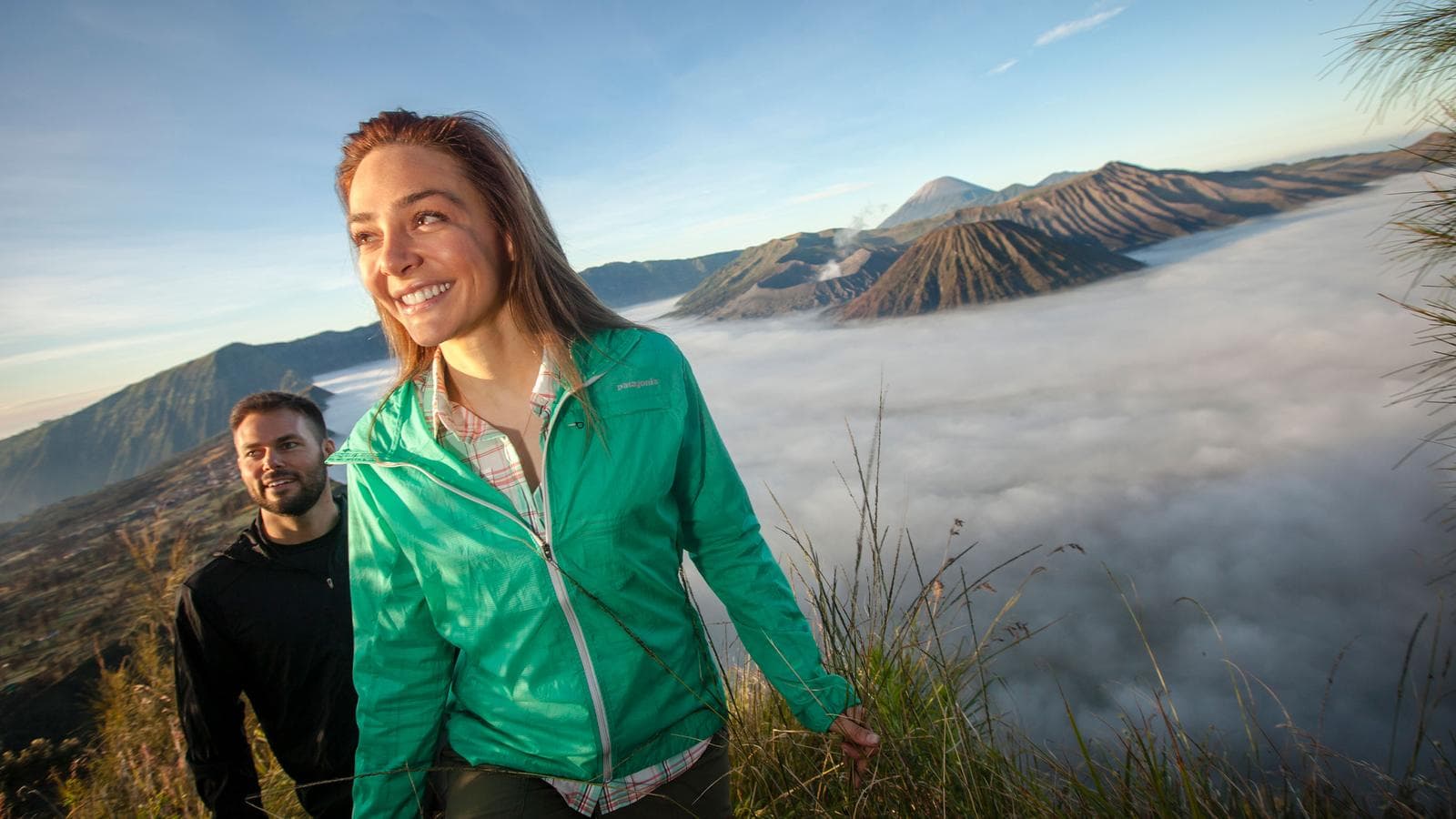
Mount Bromo is not extinct, not especially tall, and not remotely quiet about it. Travellers climb it before dawn anyway, for a view across a sea of volcanic sand few other places can offer.
By Arthur Penhallow26 September 20263 min read
Mount Bromo is not, by any measure, Java's biggest volcano. At around 2,300 metres it is dwarfed by several of its neighbours in the Tengger massif, one of which, Semeru, is the island's tallest peak and rarely stops venting entirely. What Bromo has instead is a setting that photographs and undersells itself in roughly equal measure: a vast caldera floor of pale volcanic sand, known locally as the Sea of Sand, out of which several younger cones rise, Bromo's own crater still audibly active among them. The caldera itself is the collapsed remnant of a much older, far larger volcano, sometimes referred to as Old Tengger, whose original crater is thought to have been more than eight kilometres across before it collapsed in on itself many thousands of years ago, leaving the flat sand plain that today's younger cones now sit inside.
Why before dawn
Nearly every visit to Bromo begins in darkness, usually somewhere around three or four in the morning, with a drive or jeep transfer to a viewpoint on the caldera rim, most commonly Mount Penanjakan. The reason is straightforward: cloud tends to build across the crater through the morning, and the clearest views, along with the particular effect of sunrise light crossing the Sea of Sand and catching Bromo's steam plume, belong to the first hour or two after dawn. It is an early, cold start for a view that then requires no further exertion to enjoy, which is not always how mountains work.
A crater with its own religion
The Tengger highlands are home to a Hindu minority in a predominantly Muslim province, the Tenggerese, who trace their presence here back to the decline of the Hindu Majapahit kingdom in the fifteenth century and have maintained their own customs in relative isolation on the mountain ever since. Their most visible tradition, an annual offering ceremony called Yadnya Kasada, involves villagers climbing into Bromo's crater to throw produce, livestock and other offerings toward the volcano, a practice rooted in a local legend about a royal couple's sacrifice to save their kingdom. It is not staged for visitors, and most itineraries will not coincide with it, but its existence is a reminder that Bromo is a working religious site as much as a viewpoint.
An early, cold start for a view that then requires no further exertion to enjoy.
Getting close, and how close is sensible
From the caldera floor, jeeps generally stop short of the final approach, leaving a walk or a short horse ride across the sand to a stairway cut into Bromo's own cone, which climbs to a rim overlooking the active crater. Sulphur fumes are usually noticeable, and access is occasionally restricted altogether when activity increases, which happens periodically and without much warning; this is, after all, a live volcano rather than a scenic backdrop arranged for the purpose.
A volcano with a genuine track record
Bromo is not a dormant curiosity kept on maps for its scenery alone. It has erupted repeatedly within living memory, including a series of eruptions in 2010 and 2011 that closed the crater to visitors for weeks at a stretch and sent ash considerable distances downwind, and smaller episodes of increased activity since. Indonesia's volcanology agency monitors the mountain continuously and operates a colour-coded alert system, and local guides and jeep drivers, who have generally lived their whole lives within sight of the crater, tend to have a clear-eyed, practical relationship with the risk rather than either dismissing it or being unduly alarmed by it. It is worth taking any access restriction on the day seriously rather than as an inconvenience to argue around.
Fitting it into a wider trip
Bromo sits within reach of Malang and Surabaya in East Java, and most itineraries treat it as one stop on a longer route between Yogyakarta's temple country and Bali, sometimes with a further leg east towards Ijen, another active crater known for its blue sulphuric flame visible at night. The early start, in practice, tends to be the least popular part of the day and the most talked about afterwards.
By Arthur Penhallow, the name Atlas & Passage’s editorial team writes under. Prices and dates in the trips below come from the operators and can change.