Culture
Hanoi's thirty-six streets, and the trades that still name them
Hanoi's Old Quarter was organised, street by street, around the guilds that worked there. Many of the street names have outlasted the guilds themselves by a very long way.
By Arthur Penhallow26 September 20263 min read
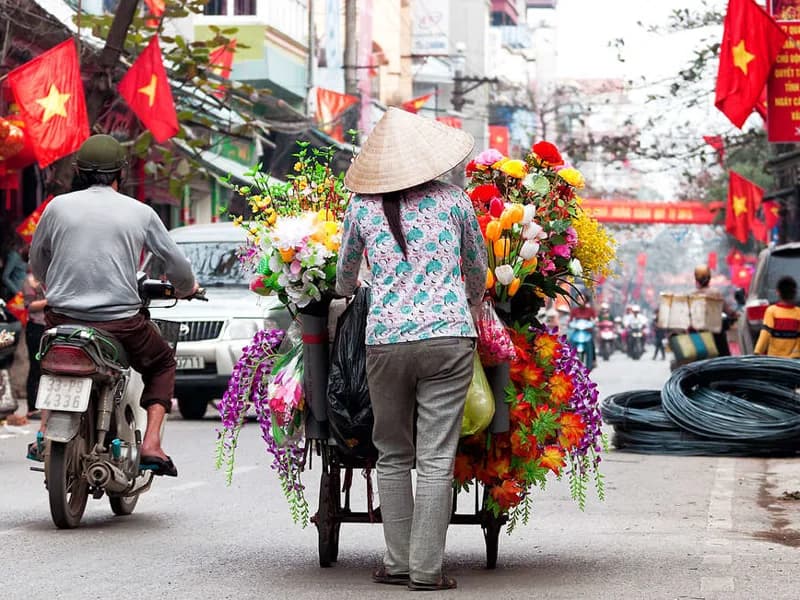
Hanoi's Old Quarter is commonly known as "Ba Muoi Sau Pho Phuong", the thirty-six streets, a name that describes an organising principle rather than an exact modern count. From around the fifteenth century, artisans and traders in this part of the city were grouped by guild, each occupying its own street: silver workers on one, silk traders on another, paper-makers, tin-smiths and coffin-makers each with a lane to themselves. Hang, the word that begins most of these street names, simply means "merchandise" or "shop", followed by whatever that particular street specialised in.
A guild system outlasting the guilds
Many of the original trades have long since moved on or vanished, and a street once dedicated exclusively to, say, silver has often filled instead with tourist shops, cafes and tailors. But the naming convention has proven remarkably durable, and enough streets still broadly match their historical trade, silk on Hang Gai, herbal medicine on Lan Ong, that walking the quarter with the old guild map in mind changes how the district reads. It becomes less a generic old town and more a fairly literal record of what Hanoi manufactured and sold for the better part of five centuries.
A capital under French rule, and after
Hanoi's status shifted considerably under nineteenth-century French colonial rule, becoming the administrative capital of French Indochina in 1902, a grouping that at its largest included what is now Vietnam, Laos and Cambodia under a single colonial government. The French built a formal administrative and residential quarter to the south of the Old Quarter, with wide boulevards, villas and public buildings in a European style, some of which survive today as government buildings, hotels and the Hanoi Opera House. That colonial history was contested from early on and ended formally with the 1954 Geneva Accords, following the French defeat at Dien Bien Phu, after which Hanoi became capital of North Vietnam and, from 1976, of a reunified Vietnam.
Hoan Kiem Lake, and a story rather than a fact
At the Old Quarter's southern edge sits Hoan Kiem Lake, whose name translates as "Lake of the Returned Sword", after a well-known legend involving the fifteenth-century Emperor Le Loi, a magic sword lent to him by a golden turtle god to defeat Chinese occupiers, and its return to the lake once the war was won. It is worth being clear that this is a legend rather than a historical record, though a genuinely large softshell turtle species did live in the lake until relatively recently, which has done nothing to discourage the story's staying power.
A district that outlasted a demolition plan too
The Old Quarter's survival was not entirely automatic even after French rule ended. Post-independence urban planning in the mid-twentieth century, and later pressure for modern development as Vietnam's economy opened up from the late 1980s onward, both put the district's low-rise, densely packed housing stock under some pressure, narrow "tube houses" only a few metres wide but running very deep behind their shopfronts, a layout that originated, according to local tradition, from a colonial-era tax assessed on street frontage rather than total floor area. Hanoi's authorities ultimately designated the quarter a protected heritage area in the 1990s, restricting redevelopment and requiring renovations to broadly respect the existing scale and style, a decision that has kept the district recognisably itself even as the city around it has grown considerably taller.
Walking it properly
The Old Quarter rewards slow movement rather than a checklist: narrow streets, motorbike traffic that takes some getting used to, and small temples and communal houses, dinh, tucked between shopfronts, several still dedicated to the guild ancestors of the trade once practised on that street. Most Vietnam itineraries begin or end here, and a morning spent simply walking, with half an eye on the street names, is arguably the most efficient possible introduction to how the city actually developed.
By Arthur Penhallow, the name Atlas & Passage’s editorial team writes under. Prices and dates in the trips below come from the operators and can change.