Rail
Japan by train, from the bullet train to the slow local lines
Japan has the most famous high-speed railway in the world, and one of the most charming networks of slow, rattling branch lines. Between them they show two quite different countries.
By Walter Pellow20 October 20264 min read
Japan's first railway opened in 1872, a short line from Tokyo to Yokohama built with British engineers and British locomotives. It was part of the Meiji government's headlong modernisation of a country that, twenty years earlier, had been closed to the world. Within a few decades the railways had reached most of the country, and they remain the backbone of Japanese travel today in a way that has no real parallel in Europe. For a visitor, the trains are not just a way of getting about. They are one of the great pleasures of the country.
The shinkansen
The Tōkaidō Shinkansen between Tokyo and Osaka opened in October 1964, days before the Tokyo Olympics, as the world's first dedicated high-speed railway. The network has since grown to reach from Kyushu in the south to Hokkaido in the north. The trains, with their long, sculpted noses, have become one of the symbols of modern Japan.
What impresses most visitors is not the speed so much as the reliability. Average delays on the main lines are measured in seconds rather than minutes, and the trains run at intervals of a few minutes at busy times. Each train stops at exactly the marked place on the platform, where passengers queue in neat lines for their carriage. Between journeys, the cleaning crews turn a train round in a few minutes, rotating every seat to face the direction of travel. Inside, the seats are wide, the carriages quiet, and a trolley comes round selling coffee, beer and snacks.
The other great pleasure is the ekiben, the station lunch box. Every region has its own, sold at stations and on platforms: rice with local fish or beef, pickles, a little sweet, in a box often designed to show off the regional speciality. Buying one before boarding and eating it at the window as the country goes by is one of the small rituals of Japanese travel.
The slow lines
The shinkansen runs through the cities and the crowded coastal plain of the Pacific side, often in tunnels or behind noise barriers. The rest of Japan is reached by the conventional lines, many of them single-track, with one or two carriages, running along valleys and coasts at a gentle pace. They are a world away from the bullet trains, and many travellers come to prefer them.
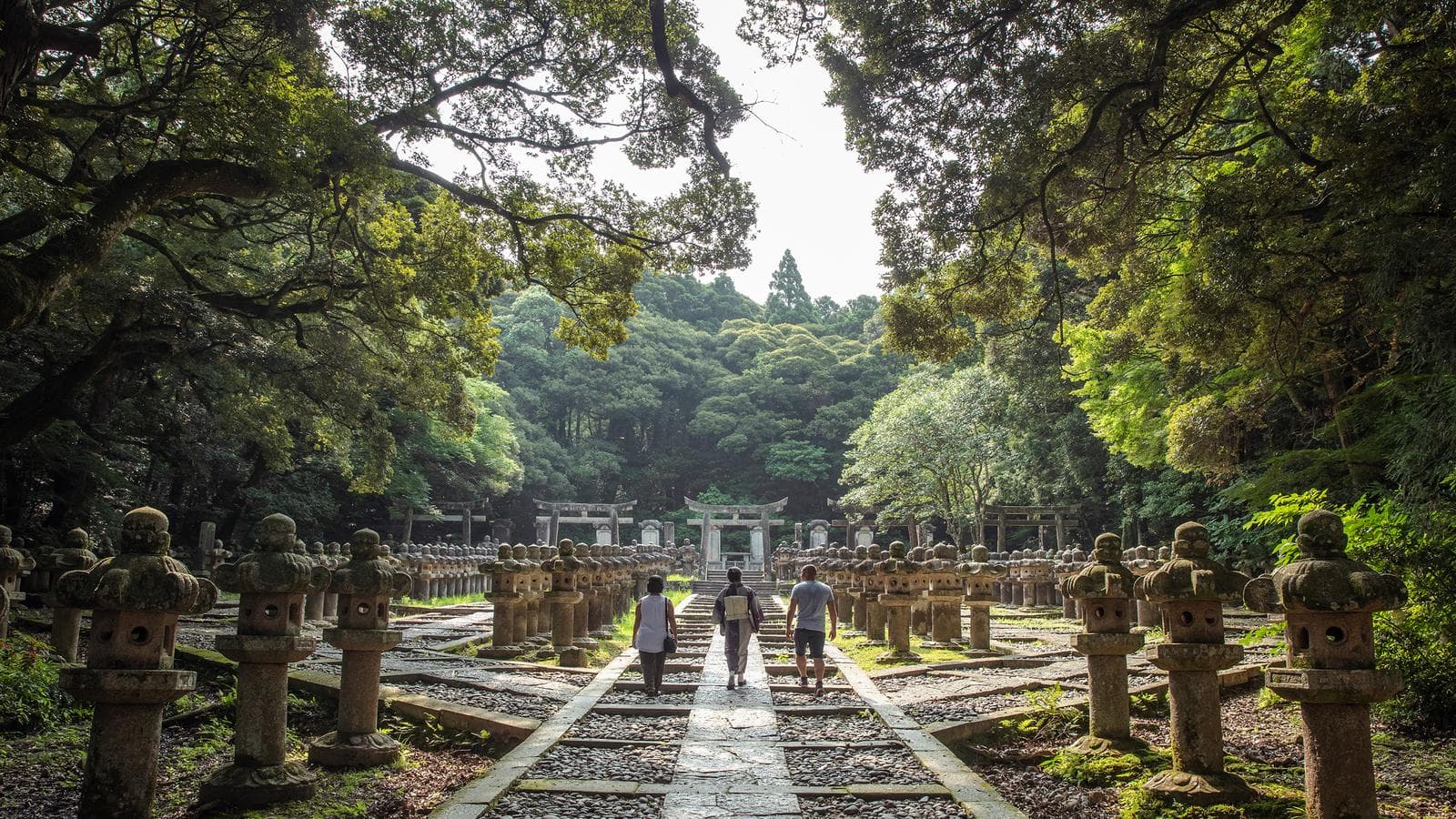
The San'in coast, on the Sea of Japan side of western Honshu, is a good example. It is far less visited than the Pacific side, with a quieter, more rural character, and its railway runs close to the sea for long stretches. Hagi, on this coast, is an old castle town of samurai houses and earthen walls, and the home of several of the men who led the Meiji Restoration in the 1860s. Its pottery is among the most prized in Japan. Tottori, further east, has the largest sand dunes in the country, an incongruous stretch of desert by the sea.
The slow lines have their own small pleasures. Many rural stations are unstaffed, with a little waiting room, a timetable on the wall and perhaps a cat. On some lines, the train is a single carriage with a driver who also collects the fares. Some branch lines run special scenic trains with large windows and wooden fittings, timed for the best of the views.
The tours, and how they travel
Each tour's mix of rail and road is in its own itinerary, and it is worth checking what is included. But the routes below are all ones that Japan's railways serve well.
G Adventures' Back Roads of Japan, ten nights from October to December, goes off the usual route, with Hagi and Tottori on the San'in coast as well as Tokyo, Kyoto, Matsumoto and Nagano.
G Adventures' Discover Japan, thirteen nights in the same season, covers the classic route, from Tokyo and Lake Kawaguchiko through Takayama and Kanazawa to Kyoto, Hiroshima and Miyajima. Just You's Japan Revealed, eleven nights for solo travellers, covers the route west from Tokyo by Atami, Kyoto, Nara and Osaka to Kobe, Okayama, Hiroshima and Miyajima Island.
Whatever route you take, try at least once to swap the bullet train for a slow local line, buy an ekiben, and watch the country go by at the speed at which it was meant to be seen.
By Walter Pellow, the name Atlas & Passage’s editorial team writes under. Prices and dates in the trips below come from the operators and can change.