Slow travel
The Dalmatian coast, a different speed by bike
The Adriatic Highway carries most of Dalmatia's traffic along a coast that was never built to take it easily. A bicycle, moving at a fraction of the speed and stopping wherever it likes, turns out to suit the terrain rather better.
By Arthur Penhallow26 September 20263 min read
The Jadranska Magistrala, Croatia's Adriatic Highway, runs the length of the Dalmatian coast in a more or less continuous ribbon of asphalt, doubling back through headlands and squeezing along ledges cut into the limestone in a manner not unlike Italy's Amalfi coast road, and carrying, particularly in July and August, considerably more traffic than a single carriageway comfortably manages. It was built in stages through the twentieth century to connect a coastline that geography had always kept fragmented into peninsulas, bays and offshore islands, and it remains, for most visitors arriving by car or coach, the only way to see the coast quickly. Quickly is, on this particular stretch of coastline, not obviously the point.
A bicycle changes the terms of the argument considerably. Moving at a walking-adjacent pace rather than a motorway one, a cyclist experiences the coast's actual topography rather than skimming over it: the climb out of a bay, the sudden view opening up around a headland, the drop back down towards the next harbour town, each felt as effort and reward rather than glimpsed through a windscreen. Much of a well-planned coastal route also avoids the busiest stretches of the Magistrala itself, using quieter back lanes through vineyards and olive groves, or the short island ferries that let a rider skip a difficult headland entirely by taking to the water instead.
Split to Dubrovnik, roughly, and the islands in between
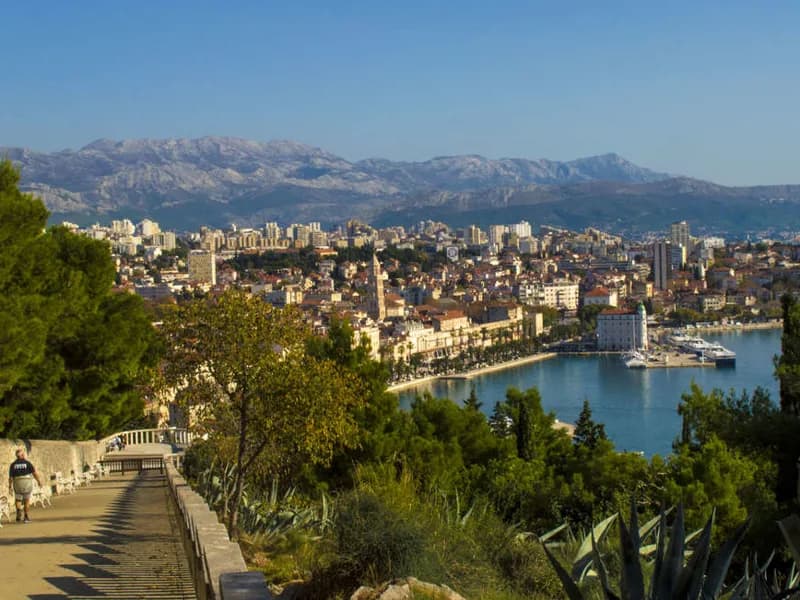
A route linking Split to Dubrovnik along this coast typically threads through Trogir, along stretches of coastline south of Split, and out to at least one of the islands, commonly Hvar or Korčula, using the same ferries that have connected these communities for longer than any road has existed. Riding onto a ferry with a loaded bicycle, rather than driving a car aboard, remains one of the more understated pleasures of Adriatic travel: a short crossing on deck, salt air, and an island arriving ahead rather than a car deck to queue for.
The Pelješac Peninsula, a long, narrow finger of land south of Split that very nearly becomes an island itself, adds a further variation: its own vineyards, producing some of Dalmatia's better-regarded red wines from steep coastal slopes, and the small walled town of Ston, whose defensive walls, built by the Republic of Ragusa to protect its salt pans, are said to be among the longest fortified walls in Europe after the Great Wall of China, a claim repeated often enough locally that it has become part of the town's identity regardless of exactly how the ranking is calculated.
South towards the border, and a different country by evening
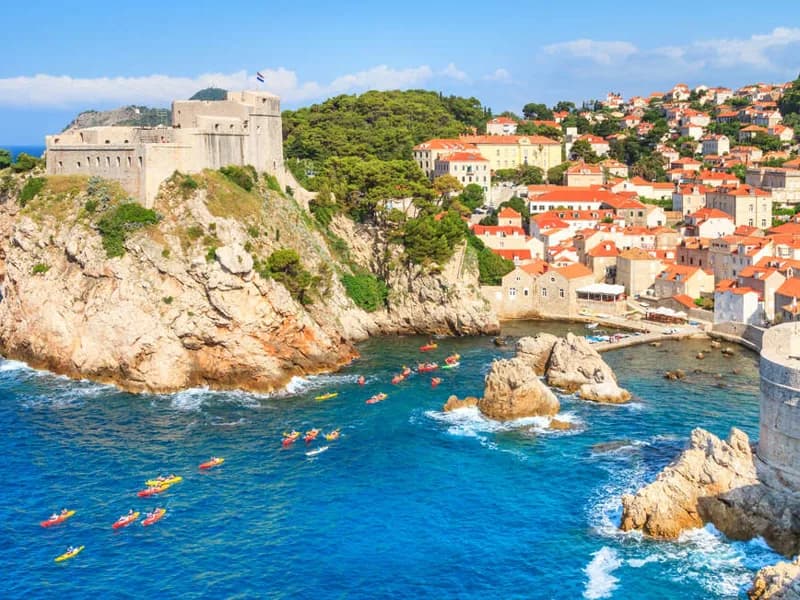
Further south, a route can continue past Dubrovnik towards the Montenegrin border, tracing the narrow strip of coastline around Konavle before climbing inland towards Mount Lovćen and on towards Montenegro's old royal capital at Cetinje, a single day's ride covering a change of country, language and, quite abruptly, altitude, as the flat coastal strip gives way to the steep limestone slopes above the Bay of Kotor. It is a considerably more physical way to cross a border than a coach window allows, and a considerably more memorable one for exactly that reason.
Late spring and early autumn suit coastal cycling in Dalmatia best: warm enough to enjoy the sea at the end of a day's ride, without the full heat of a Croatian July and August making the climbs between bays a genuine test of endurance rather than a pleasure. Most routes are graded to suit a reasonably fit but not necessarily expert rider, with support vehicles typically on hand to carry luggage between overnight stops and to pick up anyone who would rather sit out a particularly steep climb, which keeps the whole trip closer to a considered, well-paced tour than an endurance event.
By Arthur Penhallow, the name Atlas & Passage’s editorial team writes under. Prices and dates in the trips below come from the operators and can change.