Slow travel
The delta where nobody quite agrees where the land stops
The Mekong Delta grows most of Vietnam's rice on land the river is still, quite literally, in the process of making.
By Arthur Penhallow26 September 20263 min read
By the time the Mekong reaches southern Vietnam, it has already crossed six countries and travelled some four thousand kilometres from a glacier on the Tibetan Plateau. What arrives at the delta is not only water but an enormous, continuous load of silt, and it is that silt, deposited and redeposited over thousands of years, that built the flat, intensely fertile land now known as Vietnam's rice bowl. The delta is still being built today, in the geological sense; the river adds new land at its mouth even as rising seas and upstream dams complicate that process further north.
A landscape organised by water rather than road
The Mekong Delta splits into two main distributaries as it nears the sea, and then further still into a dense mesh of smaller channels, canals and tributaries that make water, not road, the delta's primary transport network in many areas. Villages here are often laid out along canal banks rather than roads, houses on stilts facing the water, and a boat is frequently the more direct way to reach a neighbour than any land route. Rice paddies extend in every direction, and Vietnam's position as one of the world's largest rice exporters rests substantially on what this delta alone produces.
Floating markets, still working
At Cai Rang, near Can Tho, and at Cai Be further upstream, boats gather each morning to trade produce directly on the water, a practice that predates road transport in the region by a considerable margin and has persisted since, even as improved roads have drawn some trade away from the canals in recent years. Traders typically hang a sample of their cargo, a bunch of bananas, a few pineapples, from a tall pole on the boat, a simple visual signal that lets buyers identify what is for sale from a distance without needing to call out over the water.
The river adds new land at its mouth even as rising seas and upstream dams complicate that process further north.
Getting through it
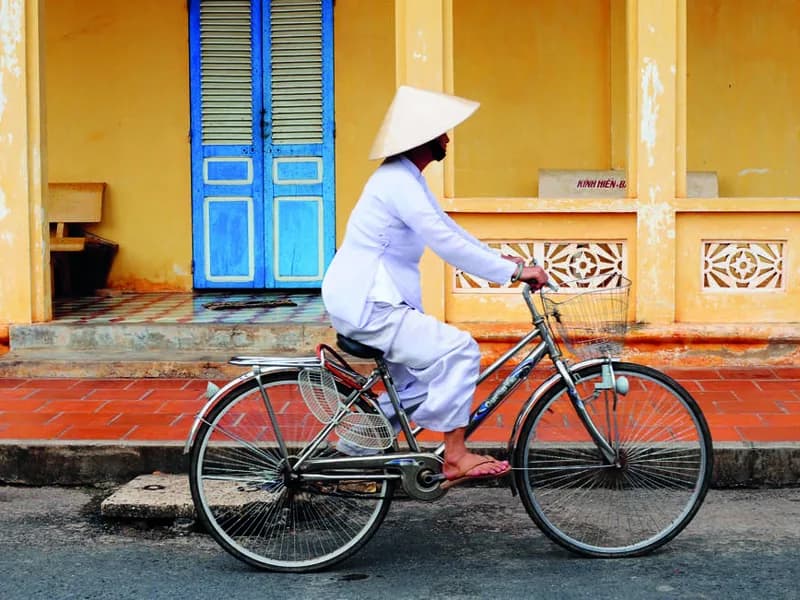
Most itineraries reach the delta from Ho Chi Minh City, either by day trip or with an overnight stay further in, and move by a combination of road and smaller boats once off the main highway, since the delta's finer waterways are simply not navigable by larger vessels. Cycling has also become a popular way to see the region at closer range, following the raised paths between paddies and canals at a pace that suits a landscape with very little vertical relief to slow anyone down, with short ferry crossings between islands standing in for the bridges a flatter, drier region might otherwise have built.
Orchards, coconut candy and a slower kind of tourism
Away from the main markets, smaller canals lead to villages built around a single crop or craft, coconut candy production near Ben Tre, fruit orchards growing longan, rambutan and dragon fruit on land raised just enough above the water table to keep roots from drowning, and workshops producing rice paper or puffed rice snacks using methods that have changed comparatively little over the decades. Many of these stops are reached only by smaller sampan boats, paddled rather than motored, along channels too narrow and too overhung with vegetation for anything larger, a scale of transport that suits the delta's own scale rather better than a tour coach would.
A region under pressure
It would be dishonest to present the delta as unchanging. Upstream dam construction on the Mekong, across several countries, has reduced the volume of silt and altered seasonal flooding patterns that the delta's farming has depended on for generations, and saltwater intrusion driven by both reduced river flow and rising sea levels has begun affecting rice yields in the delta's more coastal districts. None of this is visible on a short visit, but it is worth knowing that the placid, green landscape most tours pass through sits under a considerable amount of change happening slowly, upstream and out of sight.
By Arthur Penhallow, the name Atlas & Passage’s editorial team writes under. Prices and dates in the trips below come from the operators and can change.