Seasons
The Galápagos in the warm season, when the sea is calm and green
The Galápagos have two seasons, not four. From about December to May the sea warms and calms, short showers turn the dry islands green, and life on the beaches gets busy.
By Walter Pellow2 November 20264 min read
The Galápagos sit on the equator, but they are not a simple tropical place. Their weather is made by the sea, and the sea around them is pushed about by currents. For part of the year cold water from the south, the Humboldt current, wraps the islands in a cool, grey mist the islanders call the garúa. For the rest, warmer water takes over, the mist burns off, and the islands get sun, heat and short, heavy showers. Most guides divide the year into the warm, wet season, roughly December to May, and the cool, dry season, roughly June to November.
Neither is a bad time to go, because the animals are there all year. But they are different trips, and the warm season has some particular things in its favour.
Calm water and green islands
The first is the sea. In the warm months it is generally calmer, which matters on a small boat where much of the travelling is done at night between islands. If you are anxious about seasickness, this is the half of the year to choose. The water is warmer too, by several degrees, and the visibility for snorkelling is often at its best: the difference between a wetsuit that is welcome and one that is essential.
The second is the colour. For much of the year the lowlands of the islands are a dry landscape of grey scrub, lava and cactus. When the warm-season rains come, usually as a downpour in the afternoon and then blue sky again, the scrub leafs out and the islands turn briefly green.
And the beaches are busy. Green sea turtles come ashore to nest on sandy beaches in these months. On Española, the marine iguanas, black for most of the year, take on red and green colours in the breeding season around the turn of the year, which has earned them the nickname of Christmas iguanas.
There are trade-offs, and it would be wrong not to mention them. The air is hot and humid in the middle of the day. The holiday weeks over Christmas and New Year are the busiest of the whole year. And Española's waved albatrosses, which nest on the island and almost nowhere else, are away at sea in the first months of the year and come back around late March or April. If the albatross is the bird you most want to see, aim for the end of the warm season rather than the beginning.
The islands on these routes
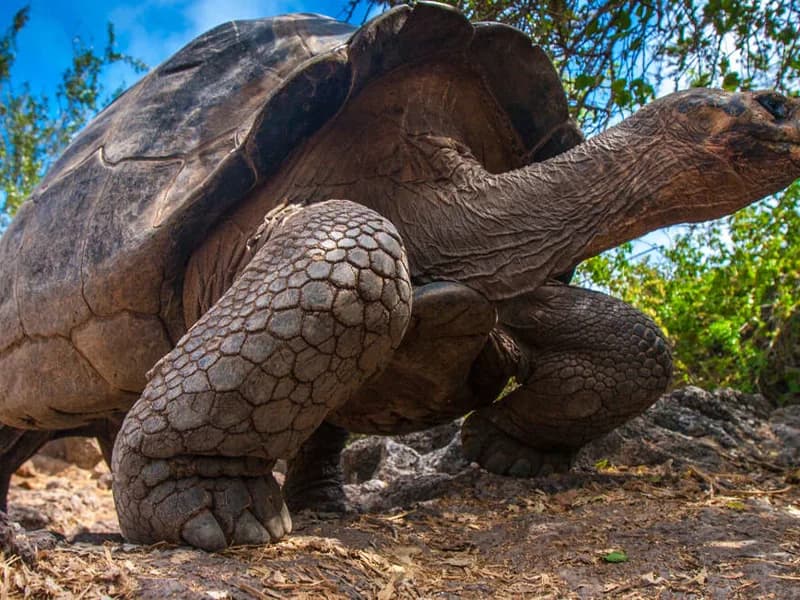
All three cruises here are on the Archipel I, and all three take in the central and southern islands. Santa Cruz is the hub, with Puerto Ayora, the islands' biggest town, and the Fausto Llerena Breeding Centre, where giant tortoises are raised; it was the home of Lonesome George, the last tortoise of the Pinta Island species, who died in 2012. Floreana is the island of Post Office Bay, where a barrel left by whalers in the late eighteenth century still takes letters that travellers carry home for one another, and of Devil's Crown, the broken crater offshore where snorkellers go. Española, the southernmost island, has the albatrosses, the iguanas, and, at Gardner Bay, a long white beach shared with sea lions.
Cruises that go there
Explore's six-night Galapagos Express, aboard the Archipel I, takes in Quito and Puembo, then Santa Cruz and Puerto Ayora, Floreana, Española, San Cristóbal and Lobos Island. It departs in every month of the year.
Explore's nine-night Galapagos - Central, South & East Islands aboard the Archipel I covers the same southern loop at greater length: Baltra, Santa Cruz and the Fausto Llerena Breeding Centre, Puerto Ayora, Floreana with Devil's Crown, Post Office Bay and the Baroness Lookout, and Española with Gardner Bay. It also departs in every month.
The nine-night Galapagos - Central, North, South and East Islands aboard the Archipel I adds the north: Bachas Beach, Genovesa, a nesting island for seabirds, and Bartolomé and Sullivan Bay, with their lava fields, before Santa Cruz, Floreana and Española.
Choose the month by what you want. January and February bring calm seas and green islands; April and May add the returning albatrosses and some of the warmest water of the year.
By Walter Pellow, the name Atlas & Passage’s editorial team writes under. Prices and dates in the trips below come from the operators and can change.