Rail
The Trans-Mongolian, from Ulaanbaatar to Beijing by train
The railway south from the Mongolian capital crosses the steppe and the Gobi to the Chinese border, where the carriages are lifted to change their wheels, before winding down through the mountains to Beijing. It is one of the great train journeys of the world.
By Walter Pellow20 October 20264 min read
The Trans-Siberian Railway is the most famous train journey in the world, running across Russia from Moscow to the Pacific. The Trans-Mongolian is its southern branch. It leaves the main line near Lake Baikal, crosses the border into Mongolia, runs south through Ulaanbaatar and across the Gobi Desert, and enters China, ending in Beijing. The line was completed in the 1950s, a product of the brief friendship between the Soviet Union, Mongolia and China, and it remains the main rail link between Mongolia and the outside world.
The stretch from Ulaanbaatar to Beijing is about a day and a half on the train, and it is the most varied part of the whole route. It begins in the green steppe of northern Mongolia, crosses the vast, empty Gobi, and ends among the mountains and the Great Wall north of Beijing.
Ulaanbaatar and the steppe
Mongolia is one of the least densely populated countries on earth: a land of grassland, mountains and desert about six times the size of the United Kingdom, with a population of a few million. Around half of them live in the capital, Ulaanbaatar, and a large share of the rest still herd horses, sheep, goats, cattle and camels across the steppe, living in round felt tents, gers, that can be taken down and moved with the seasons.
Ulaanbaatar is a sprawling city of Soviet-era blocks, new towers and ger districts on the hillsides. Its sights tell the story of a country that has been through a great deal. The Gandan Monastery is the most important Buddhist monastery in Mongolia, one of the few to survive the purges of the 1930s, when the communist government destroyed hundreds of monasteries and killed or imprisoned many thousands of monks. It now has a lively community again, and a towering gilded statue of the bodhisattva of compassion. The Winter Palace of the Bogd Khan, Mongolia's last religious ruler, is a small complex of temples and a palace from the early twentieth century, preserved as a museum.
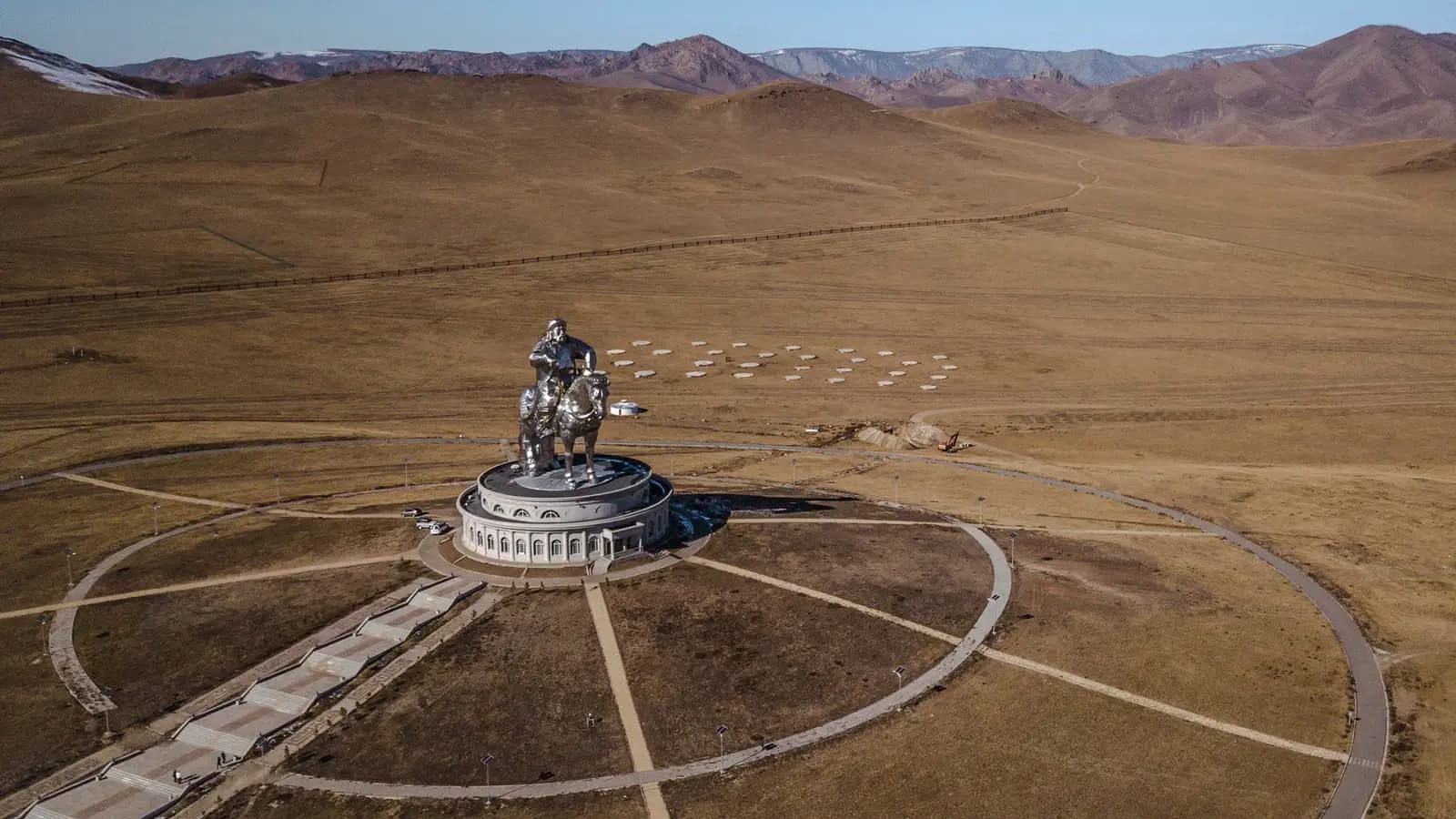
Outside the city lies Gorkhi-Terelj National Park, a landscape of granite outcrops, pine forest and river valleys, with the Aryaval meditation temple up on a hillside. On the open steppe stands the vast stainless steel Genghis Khan Equestrian Statue, completed in 2008, forty metres high, which can be climbed for a view across the grassland. Further west, Khugnu Khan mountain and the ruins of the Uvgun monastery, destroyed in the purges, sit beside Elsen Tasarkhai, a long strip of sand dunes in the middle of the steppe.
Across the Gobi, and the change of wheels
South of Ulaanbaatar, the train runs for hours across the Gobi, a high, cold desert of gravel plains, scrub and low hills rather than the sand dunes most people imagine. Herds of camels and the occasional ger are often the only signs of life.
At the border, something unusual happens. Mongolia's railways, like Russia's, use a broader track gauge than China's, and the carriages must be adapted before the train can continue. At the Chinese border station of Erenhot, the whole train is taken into a large shed, the carriages are lifted on jacks with the passengers still inside, and the wheel sets underneath are exchanged for ones of the Chinese gauge. The process takes a few hours, usually at night, and is one of the most memorable moments of the journey.
After that, the line crosses Inner Mongolia and climbs into the mountains north of Beijing, past stretches of the Great Wall, before descending to the capital.
The tours that ride the line
G Adventures' Mongolia to China: The Trans-Mongolian Railway, fifteen nights from May to July, spends time in Mongolia as well as on the railway. Its places include Ulaanbaatar with the Gandan Monastery and the Bogd Khan Palace, Gorkhi-Terelj and the Aryaval monastery, the Genghis Khan statue, Khugnu Khan mountain and the Uvgun monastery, and Elsen Tasarkhai. It ends in Beijing, with the Great Wall and Tiananmen Square.
G Adventures' Mongolia to Beijing by Rail, eight nights in the same season, is a shorter version, from Ulaanbaatar to Elsen Tasarkhai, Khugnu Khan and Gorkhi-Terelj, and on to Beijing.
Summer is the season to go, when the steppe is green and Mongolia holds its great summer festival, Naadam, in July. The trip ends in one of the world's great capitals. The memory that tends to stay is of the empty land, the huge sky and the long hours of looking out of the window.
By Walter Pellow, the name Atlas & Passage’s editorial team writes under. Prices and dates in the trips below come from the operators and can change.