History
Xi'an beyond the warriors: the city wall and the Muslim Quarter
Most visitors come to Xi'an for the Terracotta Army and leave the next day. They miss a great deal. The city was the capital of China for many centuries and the eastern end of the Silk Road, and its walls, pagodas and Muslim Quarter tell that story better than any museum.
By Walter Pellow20 October 20264 min read
The Terracotta Army is one of the great archaeological discoveries of the twentieth century, and it deserves its fame. In 1974 farmers digging a well outside Xi'an found fragments of pottery figures. They had come upon the edge of a vast underground army of life-size soldiers, horses and chariots, buried to guard the tomb of Qin Shi Huang, the ruler who united China in 221 BC and declared himself its first emperor. Thousands of figures have been excavated, no two faces alike, and work continues. It is a must on any visit.
But it lies some way outside the city, and many tours treat Xi'an as a place to see the warriors and move on. That is a pity, because the city itself has a long and remarkable history. As Chang'an, it was the capital of a series of dynasties, above all the Tang, from the seventh to the early tenth century, when it was one of the largest and most cosmopolitan cities in the world. Merchants, monks and envoys arrived from Persia, Central Asia, India, Korea and Japan. It was the eastern terminus of the Silk Road, and its influence spread across East Asia: both Nara and Kyoto, in Japan, were laid out on its plan.
The city wall
Xi'an's city wall is one of the most complete old city walls in China. The present wall was built in the early Ming dynasty, in the late fourteenth century, on the line of the Tang imperial city. It runs for about fourteen kilometres around the old centre, a massive rampart of grey brick with gate towers, watchtowers and a moat. It is broad enough on top to walk, or better still to cycle, the whole circuit, and bicycles can be hired on the wall itself. The ride takes a couple of hours at a gentle pace and gives a view over the rooftops of the old city on one side and the modern city on the other.
At the centre of the walled city stand the Bell Tower and the Drum Tower, which once marked the hours of the day. They are lit up at night and are especially fine from the wall or the square between them.
The Muslim Quarter
Behind the Drum Tower lies the Muslim Quarter, home for centuries to the Hui, Chinese-speaking Muslims descended in part from the Persian, Arab and Central Asian merchants who settled along the Silk Road. Its narrow streets are full of food stalls, butchers, bakers and sweet shops, and in the evening it is one of the liveliest places in the city.
The food is the reason to go. Roujiamo, sometimes called the Chinese burger, is shredded meat stuffed in a flatbread. Yangrou paomo is a rich mutton soup into which you tear your own flatbread. There are skewers of spiced lamb grilled over charcoal, and biangbiang noodles, wide hand-pulled ribbons whose name is written with one of the most complex characters in the Chinese language.
The Great Mosque, tucked away in the lanes, is one of the oldest and largest mosques in China, built in the style of a Chinese temple, with courtyards, gardens, pavilions and a minaret that looks like a pagoda. It is a quiet and unexpected place.
The Big Wild Goose Pagoda, and the tours
South of the walls, the Big Wild Goose Pagoda was built in the seventh century to store the Buddhist scriptures brought back from India by the monk Xuanzang, whose journey inspired the classic novel Journey to the West.
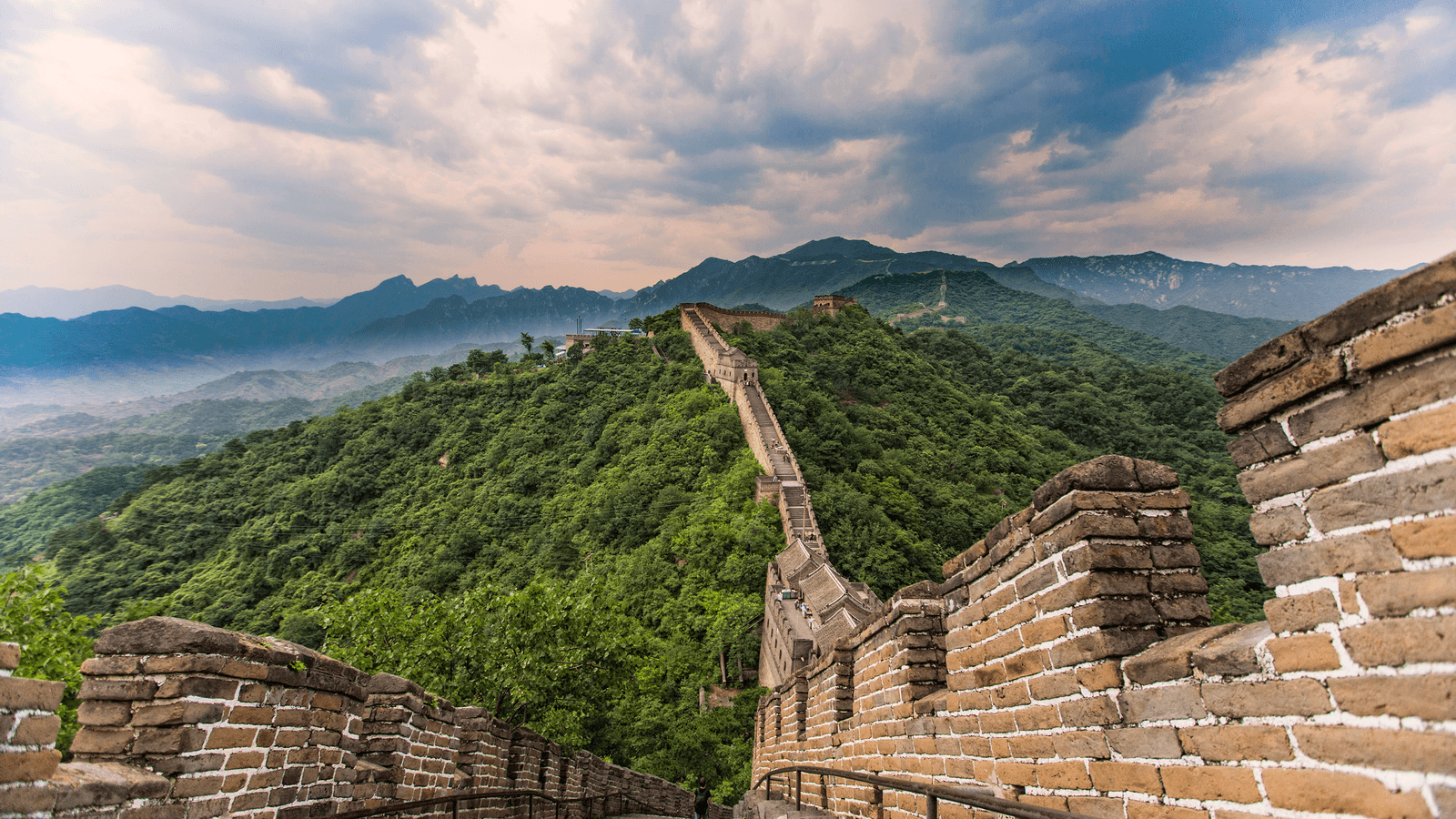
Explore Worldwide's Imperial China: Shanghai, Xi'an and Beijing, seven nights in spring and autumn, includes Xi'an and its Muslim Quarter, with Shanghai, Suzhou, Beijing and the Great Wall at Mutianyu.
G Adventures' China: Cultural Sites and Epic Cities, six nights in December, combines Xi'an with Beijing, Mutianyu and Chengdu. G Adventures' Highlights of China, fourteen nights in December, adds Leshan and Emei Shan, Yangshuo and Shanghai to Beijing, Xi'an and Chengdu.
If you can, give Xi'an two days: one for the warriors, and one for the wall, the Muslim Quarter and an evening of noodles and lamb skewers.
By Walter Pellow, the name Atlas & Passage’s editorial team writes under. Prices and dates in the trips below come from the operators and can change.