History
Kanazawa, the castle town the war passed by
Kanazawa was the seat of the richest feudal lords in Japan, and it escaped the bombing that destroyed so many Japanese cities in 1945. Its geisha streets, samurai quarter and great garden survive, along with a taste for gold leaf.
By Walter Pellow20 October 20264 min read
Most Japanese cities were heavily bombed in the last year of the Second World War, and much of what visitors see in them today was built after 1945. Kanazawa, on the Sea of Japan coast of central Honshu, was one of the few large cities that escaped, and its old districts survive to an unusual degree. Add a famous garden, a lively fish market and a long tradition of fine crafts, and it is easy to see why it is often called a little Kyoto, though it has a character of its own.
The richest domain in Japan
From the late sixteenth century until the 1860s, Kanazawa was the castle town of the Maeda family, lords of the domain of Kaga. Under the Tokugawa shoguns, Kaga was the richest of the feudal domains, rated at more than a million koku, the measure of rice that expressed a lord's wealth. Because a domain so rich might be seen as a threat to the shoguns, the Maeda lords channelled their money into culture rather than armies. They became great patrons of the arts, of the tea ceremony, of Noh theatre and of crafts such as lacquer, ceramics and silk dyeing. The city still makes almost all of Japan's gold leaf, which turns up on everything from lacquerware and temple decorations to ice cream.
Kenroku-en
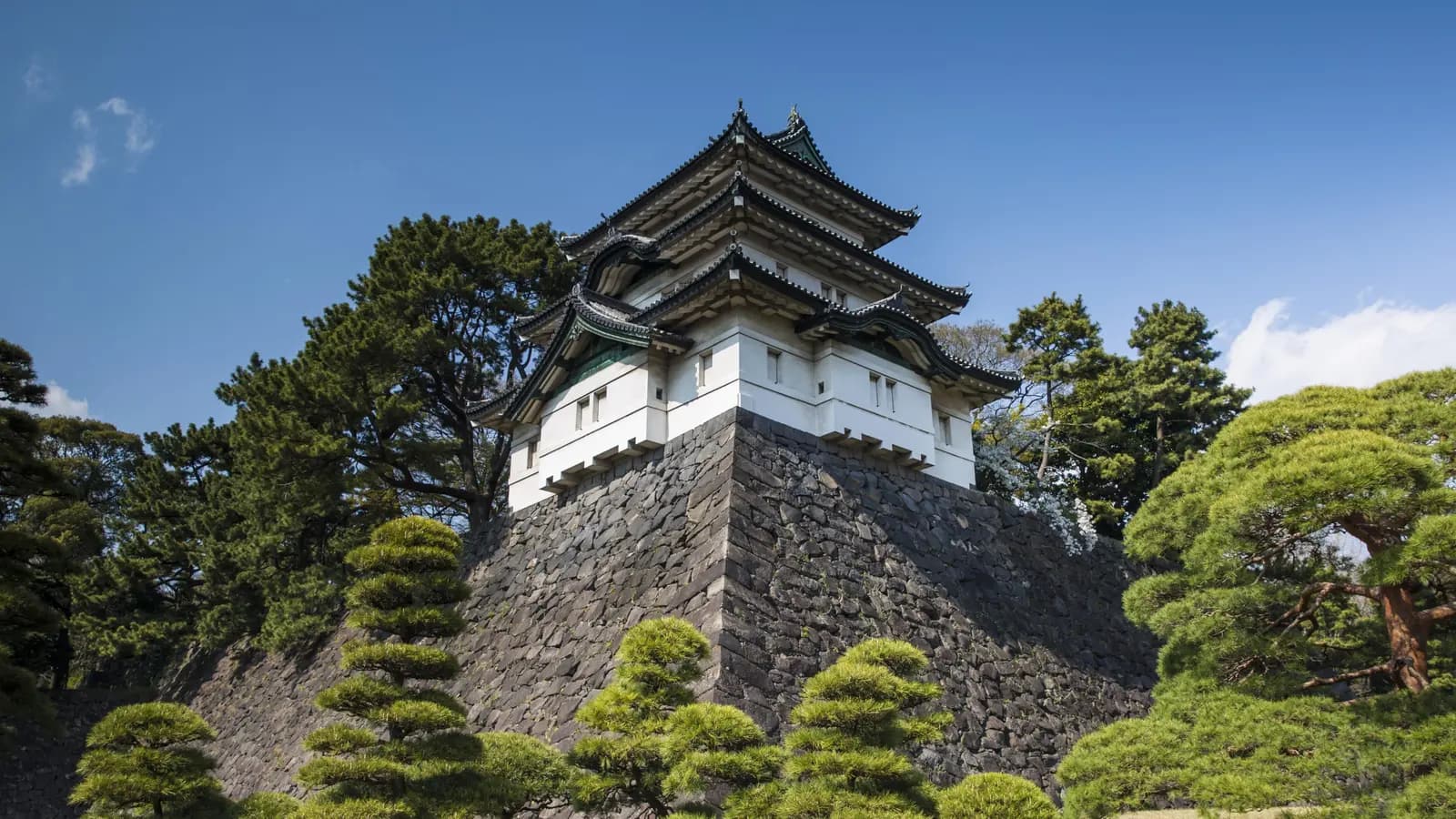
Kenroku-en, the garden built by the Maeda lords beside their castle, is one of the three most celebrated landscape gardens in Japan. Its name means "garden combining six qualities", among them spaciousness and seclusion, artifice and antiquity, water and views. It was developed over nearly two centuries into a strolling garden of ponds, streams, bridges, teahouses, moss and carefully shaped pines. It is beautiful in every season. In winter, the branches of the pines are supported by ropes strung from a central pole, like the ribs of an umbrella, to stop them from breaking under the heavy snow, a practice called yukitsuri that is one of Kanazawa's best-known sights. The castle next door, largely rebuilt, has massive stone walls and white-walled storehouses with lead-tiled roofs.
Geisha streets and samurai lanes
Higashi Chaya, across the river from the castle, is one of the best-preserved old entertainment districts in Japan, a street of two-storey wooden teahouses with fine latticed fronts. A few teahouses still host geisha entertainment for invited guests, and others are now cafés, shops and museums. One of them, open to visitors, shows the elegant upstairs rooms where guests were entertained. Nagamachi, near the centre, was the samurai district. Its narrow lanes are lined with earthen walls under small tiled roofs, protected in winter by straw mats, and a few of the old samurai residences are open to the public.
Omichō Market, which has fed the city for around three centuries, is the place for the seafood of the Sea of Japan. Snow crab in winter, sweet shrimp, and bowls of rice heaped with raw fish are eaten at counters at the back of the stalls. The modern city has its own attractions too, notably the 21st Century Museum of Contemporary Art, a circular glass building with works designed to be walked through and around.
Kanazawa is easier to reach than it once was. The Hokuriku Shinkansen, extended to the city in 2015, brought it within a few hours of Tokyo by bullet train, and visitor numbers have grown accordingly. Its old districts are still at their quietest early in the morning, as in so many Japanese towns.
The tours that stop there
Kanazawa sits on many of the classic Japan routes, between the mountains of Takayama and the coast. G Adventures' Discover Japan, thirteen nights from October to December, includes it with Tokyo, Lake Kawaguchiko, Takayama, Kyoto, Hiroshima and Miyajima.
Explore Worldwide's Highlights of Japan, seven nights, includes Kanazawa with Tokyo, Nagano and the snow monkeys of Jigokudani, Osaka, Hiroshima and Kyoto. Explore Worldwide's Simply Japan, thirteen nights, runs all year round and adds Kanazawa to Matsumoto, Takayama and Arashiyama. A winter departure would show Kenroku-en under snow.
Kanazawa repays a slower pace than most Japanese cities. Spend a morning in the garden, an afternoon in the teahouse district, and an evening over seafood from the market, and you will have seen the city much as the Maeda lords meant it to be seen.
By Walter Pellow, the name Atlas & Passage’s editorial team writes under. Prices and dates in the trips below come from the operators and can change.