History
Nagasaki, Japan's one window on the West for two centuries
For more than two hundred years, while Japan kept the rest of the world at arm's length, a small artificial island in Nagasaki harbour was the only place where Europeans were allowed to trade. The city's history is stranger and more cosmopolitan than its later fame suggests.
By Walter Pellow20 October 20264 min read
The first Europeans to reach Japan were Portuguese traders, blown off course to the island of Tanegashima in 1543. Within a few decades they had established a lucrative trade, and Jesuit missionaries, led at first by Francis Xavier, had converted a substantial number of Japanese, including several feudal lords in the island of Kyushu. One of them, a Christian lord, opened the fishing village of Nagasaki to Portuguese ships in 1571, and it grew rapidly into a busy port with churches, Portuguese merchants and a large Christian population.
The welcome didn't last. Japan's new rulers came to see Christianity as a threat to their authority. In 1597, twenty-six Christians were crucified on a hill in Nagasaki. In the early seventeenth century the religion was banned outright and its followers persecuted. After a rebellion on the Shimabara peninsula in 1637 and 1638, involving many Christian peasants, the Tokugawa shoguns closed the country almost entirely. Japanese were forbidden to leave, the Portuguese were expelled, and foreign trade was restricted to a handful of tightly controlled channels. The policy lasted until the 1850s.
Dejima
The one European exception was the Dutch. As Protestants interested in trade rather than conversion, they were allowed to stay, but only on Dejima, a small fan-shaped artificial island in Nagasaki harbour, built in the 1630s and joined to the city by a single guarded bridge. For more than two centuries, a handful of employees of the Dutch East India Company lived and worked there, rarely allowed to leave. Through this tiny opening came European books, medicine, science and curiosities, studied by Japanese scholars as rangaku, "Dutch learning". Chinese traders, too, had their own walled quarter in the city.
Dejima was later swallowed by land reclamation, and for many years it was simply part of the city. It has since been carefully reconstructed, with its warehouses, residences and offices rebuilt in their original form, and it gives a vivid sense of the odd, confined life of its inhabitants.
Hidden Christians, and the opening of Japan
The persecution did not entirely succeed. In remote villages and islands around Nagasaki, communities of Christians kept their faith in secret for two and a half centuries, disguising their prayers and images as Buddhist ones. When Japan reopened to the West in the 1850s, a French church was built for foreign residents on the hillside above the harbour. In 1865, a group of villagers came to its priest and revealed that they shared his faith, one of the more extraordinary moments in the history of Christianity. That church, Oura Cathedral, is the oldest surviving church in Japan. The sites associated with the hidden Christians in the region are now a World Heritage Site.
Above Oura, Glover Garden preserves the houses of the Western merchants who settled in Nagasaki after 1859, including that of Thomas Glover, a Scottish trader who played a part in Japan's industrialisation and its first modern shipyards and coal mines.
Nagasaki's later history is the one the world knows. On 9 August 1945 it became the second city destroyed by an atomic bomb. The Peace Park, near the hypocentre, and the atomic bomb museum tell that story with the same seriousness as Hiroshima's.
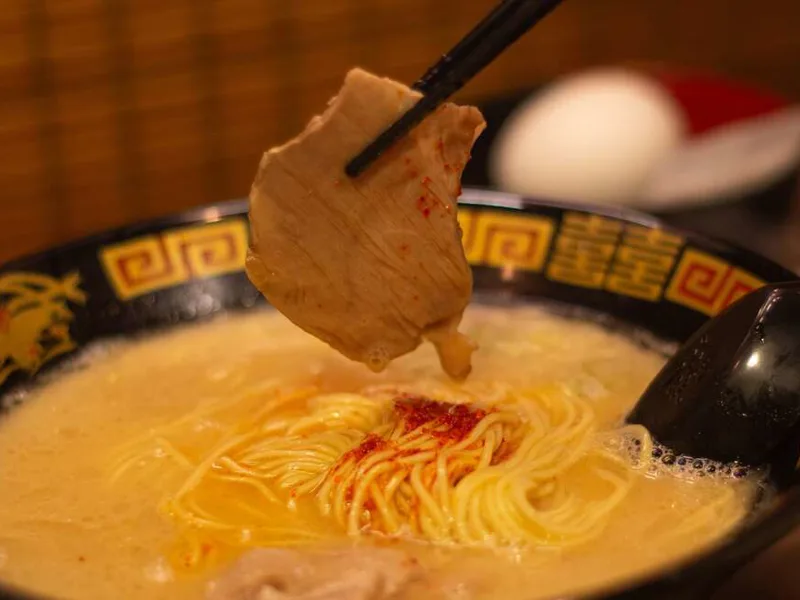
The city's mixed past shows in its food. Champon, a hearty noodle soup loaded with seafood, pork and vegetables, was created in Nagasaki for Chinese students. Castella, a light sponge cake, descends from a recipe brought by the Portuguese. Both are still sold all over the city, and both are worth trying.
The tours that go
Explore Worldwide's Highlights of Japan: Kyushu Island, eight nights, includes Fukuoka, with the shrine of Dazaifu Tenmangu, the Zen temple of Komyozenji, Ohori Park, Tochoji temple and the Hakata Machiya Folk Museum. In Nagasaki its places include the Peace Park, Dejima, Glover Garden and Oura Cathedral, as well as the port of Shimabara.
Explore Worldwide's Japan In Depth: Footsteps of the Shogun, eleven nights, combines Tokyo, Hakone, Kyoto and Hiroshima with Nagasaki and the north-west of Kyushu. It includes Hirado Island, where the Dutch and the English kept trading posts before Dejima, Ikitsuki Island, Sasebo and Fukuoka.
Nagasaki is a hilly, harbourside city with a gentler character than most Japanese cities, shaped by its long contact with the outside world. It is worth giving it more than a day.
By Walter Pellow, the name Atlas & Passage’s editorial team writes under. Prices and dates in the trips below come from the operators and can change.